
Planning a safari in Tanzania is an exciting experience, and we want you to feel prepared long before you arrive. Whether this is your first safari or you are returning to Africa, knowing what to pack and what to expect can make your journey more comfortable and enjoyable.
At Tales of Tanzania Safaris, we believe a wonderful safari is about more than the wildlife you encounter. It is also about feeling looked after, having the right information, and being able to relax and enjoy each moment.
We have put together this practical guide to help you prepare for your Tanzania safari, from choosing the right clothing and packing your luggage to understanding travel arrangements, life in the bush, and what to expect if your journey includes Zanzibar.
1. Tanzania Safari Packing List: What to Pack & Practical Travel Tips
You do not need to bring everything you own to enjoy a safari. The key is to pack comfortably, choose versatile items, and leave a little room for the unexpected treasures you may find along the way.
Essential Packing Checklist
Clothing
- Lightweight, breathable shirts and trousers.
- Neutral or natural colours such as khaki, beige, brown, olive, and grey.
- A warm fleece, jumper, or light jacket for early-morning game drives and cooler evenings.
- Long-sleeved shirts and long trousers for extra sun and insect protection.
- Comfortable casual clothing for relaxing at your lodge or camp.
- Underwear, socks, sleepwear, and a few extra changes of clothing.
- A swimsuit if your accommodation has a swimming pool or you are continuing to the coast or Zanzibar.
- A light rain jacket, particularly if travelling during the rainy seasons.
Footwear
- Comfortable walking shoes or trainers.
- Sandals or comfortable shoes for relaxing at your accommodation.
- Sturdy walking shoes or hiking boots if your itinerary includes walking activities or trekking.
Sun and insect protection
- Sunscreen with a suitable SPF.
- Sunglasses with UV protection.
- A wide-brimmed hat or cap.
- Insect repellent.
- Lip balm and personal toiletries.
- Any personal medication you need during the trip.
Safari essentials
- Binoculars for watching wildlife from a comfortable distance.
- A camera or smartphone, with spare batteries or a power bank.
- Charging cables and any camera accessories you use.
- A small day bag for personal items.
- A reusable water bottle, where appropriate.
- Tissues, wet wipes, and hand sanitiser.
- A small torch or headlamp, especially useful at some tented camps.
- Copies of important travel documents, stored separately from the originals.
If you take prescription medication, bring enough for the full trip and keep it in your hand luggage. It is also sensible to carry a basic personal first-aid kit with items suitable for your needs.
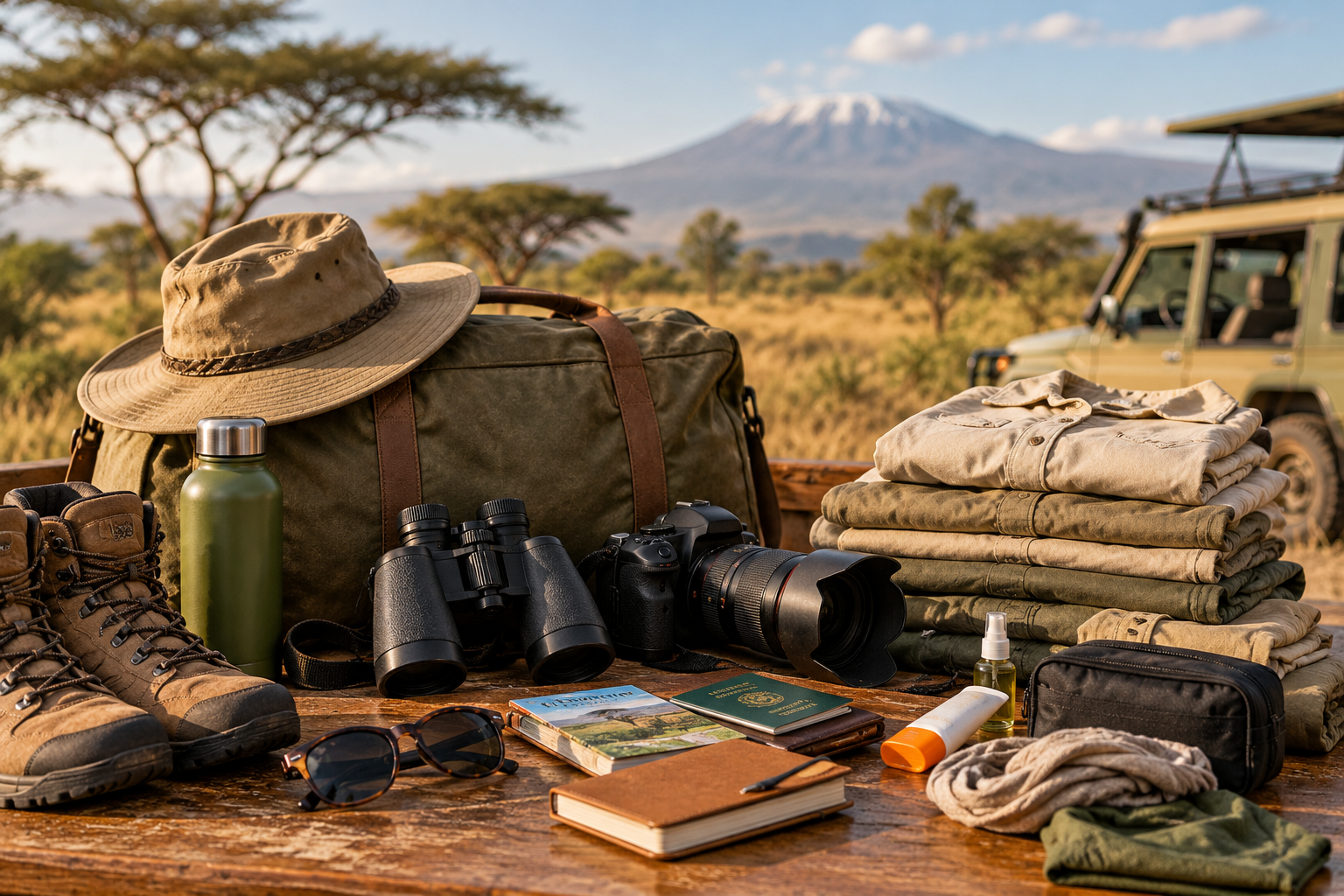
2. What to Wear on Safari
Safari clothing is best kept comfortable and practical. You will spend time in the vehicle, sometimes for several hours, and temperatures can change considerably between early morning, midday, and evening.
Neutral colours such as khaki, beige, olive, and brown work well. They are comfortable for the bush and help you blend into the surroundings. Bright colours are not generally necessary, and very dark clothing can attract more heat and insects in some conditions.
You do not need a completely new safari wardrobe. Comfortable everyday outdoor clothing is usually sufficient.
For early-morning game drives, bring a warm layer that you can remove as the day warms up. Even in warmer months, mornings in open safari vehicles can feel surprisingly cold, especially in the Ngorongoro Highlands and other higher-altitude areas.
If your itinerary includes a mountain trek or another specialist activity, follow the specific clothing and equipment advice provided for that activity.

3. Weather and How to Prepare
Tanzania has different climates depending on the region, altitude, and time of year. The weather in Arusha, the Ngorongoro Highlands, the Serengeti, and Zanzibar can feel quite different during the same trip.
Days can be warm and sunny, while early mornings and evenings may be cool. Rain is also possible, particularly during the rainy seasons.
Our advice is to pack layers rather than relying on one type of clothing. A light jacket, a warm fleece, breathable daytime clothes, and a rain layer will give you flexibility.
If you are travelling during a particular season, we can advise you on what to expect in the areas included in your itinerary. This is especially helpful when combining several destinations, as conditions may vary throughout your journey.

4. Luggage and Domestic Flights
If your safari includes a domestic flight, luggage allowances are particularly important. Small safari aircraft often have stricter baggage limits than international airlines, and the allowance can vary between carriers and routes.
Some flights may allow around 15–20 kg in total, while others have different allowances. For example, certain Flightlink fares have been listed with 20 kg of checked luggage plus 5 kg of carry-on baggage. These figures are examples only, not a universal allowance.
Always check the exact baggage allowance for your booked flight before travelling. Pay attention to whether hand luggage is included in the total weight and whether there are restrictions on bag dimensions.
Soft-sided luggage is generally recommended for many small safari aircraft because it is easier to fit into limited storage space. Large, rigid suitcases may not be suitable for some flights.
We recommend:
- Packing as lightly as you comfortably can.
- Using soft-sided bags when required by your flight operator.
- Keeping passports, medication, valuables, and essential items in your hand luggage.
- Checking baggage rules for each domestic flight in your itinerary.
- Asking us in advance if you are unsure whether your luggage will be suitable.
If your itinerary combines a safari with Zanzibar or another destination, we can help you plan your luggage around the full journey

5. Flights, Arrival and Airport Transfers
For a relaxed start to your safari, we generally recommend arriving in Tanzania at least one day before your safari begins, particularly if you are travelling on a long international flight or arriving late in the evening.
This gives you time to clear immigration, collect your luggage, transfer to your accommodation, and rest before your first game drive.
Immigration and baggage collection can take time, especially when several international flights arrive close together. Please allow enough time when planning onward connections.
Kilimanjaro International Airport is commonly used for safaris in northern Tanzania. Depending on your accommodation and itinerary, your transfer may take a different amount of time. We will advise you on the best arrival arrangements for your particular journey.
If you experience a flight delay or your luggage does not arrive, please contact us as soon as possible so we can help coordinate the necessary arrangements.

6. Passports, Visas and Travel Documents
Before travelling, check that your passport is valid for the period required by Tanzanian immigration and has sufficient space for any necessary entry stamps.
Visa requirements depend on your nationality, travel purpose, and circumstances. Some travellers may be eligible to apply online, while others may have different requirements. Please consult the official Tanzania Immigration website before departure rather than relying on assumptions about visa-on-arrival eligibility.
Keep the following documents accessible:
- Your passport and any required visa or entry approval.
- Your international and domestic flight details.
- Your safari itinerary and accommodation information.
- Your travel insurance documents.
- Your mandatory inbound travel insurance certificate, where applicable.
- Emergency contact details and copies of important documents.
It is helpful to keep digital copies securely on your phone or email, as well as a separate copy of essential documents.
7. Travel Insurance and Health Preparations
We strongly recommend comprehensive travel insurance that suits your individual needs. Depending on the policy, it may help cover unexpected medical expenses, trip interruption, baggage problems, and emergency evacuation. Always read the policy carefully to understand its benefits, limits, and exclusions.
Mandatory inbound travel insurance for Tanzania
As of October 2026, foreign visitors entering Tanzania are generally required to obtain the applicable government inbound travel insurance, subject to the relevant exemptions and rules.
The applicable provider depends on your first point of entry:
- If your first point of entry is Tanzania Mainland: consult the National Insurance Corporation (NIC) at https://inbound.nicinsurance.co.tz/
- If your first point of entry is Zanzibar: consult the Zanzibar Insurance Corporation (ZIC) at https://inbound.visitzanzibar.go.tz/
The published premium is the equivalent of US$44 per visitor, with cover for up to 92 days, subject to the policy terms and applicable requirements. Travellers combining mainland Tanzania and Zanzibar generally do not need to purchase duplicate inbound policies for the same journey if they already hold a valid applicable policy. Check the official guidance for your circumstances and keep your insurance certificate accessible throughout your trip.
This government policy is not a substitute for comprehensive travel insurance that covers your personal needs.
You should also seek advice from your healthcare professional or an appropriate travel health clinic well before departure. They can advise you on vaccinations, malaria prevention, and other precautions based on your itinerary and medical circumstances. Yellow fever certificate requirements depend on your travel history and the countries from which you are arriving or transiting.
Bring any medication you need and keep it in its original packaging where possible. If you have dietary, mobility, or other requirements that may affect your comfort during the trip, please let us know in advance.
8. Money, Currency and Tipping
The Tanzanian shilling is the local currency, while US dollars are commonly used for many tourism-related payments. However, the acceptance of foreign currency, card payments, and cash can vary by business and location.
We recommend:
- Carrying some small-denomination local currency for everyday purchases.
- Keeping cash secure and carrying only what you need for the day.
- Informing your bank before travelling if you plan to use your cards abroad.
- Checking that any US dollar notes you bring meet the requirements of the businesses or services you intend to pay.
- Keeping a separate reserve for unexpected expenses.
ATMs and card facilities may be available in larger towns, but access can be limited in remote safari areas. Do not rely on being able to withdraw cash once you are deep in the bush.
What about tipping?
Tipping is a personal choice and a way some travellers choose to show appreciation for good service. It is not a requirement, and the amount depends on your budget, the service received, and your own preference.
You may wish to tip your driver-guide at the end of the safari and leave a tip for lodge or camp staff if you feel their service deserves it. Some properties have shared staff tip boxes, while others provide different arrangements.
If you would like guidance on customary tipping amounts for your particular itinerary, please ask us before travelling. We would rather give you advice that fits your trip than suggest one fixed amount for every traveller and situation.
9. What to Expect During Your Safari
A safari is an adventure, and every day can be different. Wildlife moves freely, so sightings can never be guaranteed. That is part of what makes each journey special.
Your days may begin early, when temperatures are cooler and wildlife is often active. Depending on your itinerary, you may enjoy a morning game drive, return to your lodge for a meal and rest, or spend much of the day exploring the park with a picnic lunch.
Meal arrangements vary by accommodation and itinerary. Breakfast may be served at the lodge or provided as a packed meal, lunch may be enjoyed at a designated picnic site or in the bush where permitted, and dinner is usually served at your accommodation.
Some days involve longer drives between destinations. We plan routes carefully, but road conditions, weather, park distances, and wildlife sightings can affect timings. Allow yourself to enjoy the journey rather than expecting every day to run exactly to the minute.
Our safaris are private, which means your journey is designed around your own group. You can discuss your interests and preferences with your driver-guide, whether you enjoy photography, birdlife, landscapes, or spending extra time observing a particular animal when conditions allow.
Food and dietary requirements
Please tell us about allergies, dietary restrictions, or preferences before your trip so we can communicate them to your accommodations. If you have a serious allergy, explain its nature and severity clearly and, where appropriate, bring any prescribed emergency medication.
Meals and menu choices vary between properties, particularly in remote camps. Giving us advance notice helps us coordinate with the lodges and camps as effectively as possible.
Charging devices and staying connected
Many safari vehicles have charging points, but availability and socket types can vary. Bring your charging cables and consider carrying a power bank for use when you are away from your accommodation.
Wi-Fi is available at some lodges and camps, but connection speeds and coverage can be limited in remote areas. Mobile coverage also varies by location. If staying connected is important to you, ask us about the options for your route.
You may be able to purchase a local SIM card in Arusha or another major town. Your phone generally needs to be unlocked to use a SIM from another network. Bring identification if required for registration.
We recommend downloading important travel documents and useful information before entering remote areas where the internet may be unreliable.

10. Staying Safe at Lodges and Tented Camps
Some safari accommodations are located in wildlife areas where animals may move freely around the camp. This is part of the special experience of staying close to nature, but it also means that a few precautions are essential.
Always follow the instructions given by your camp or lodge staff. At some tented camps, staff may escort guests between their tents and the main areas after dark. Please request an escort whenever the property requires it.
Other important reminders:
- Never approach, feed, or attempt to touch wild animals.
- Do not leave your accommodation at night unless staff have confirmed it is safe to do so.
- Keep tent or room doors zipped or closed as instructed.
- Do not leave food or rubbish where it may attract wildlife.
- Listen carefully to your guide and camp staff, even if an animal appears calm.
- Keep valuables secure and avoid displaying large amounts of cash.
Wild animals are unpredictable, and even familiar-looking species must be treated with respect. Your guide and accommodation team are there to help you enjoy the experience safely.

11. Photography, Binoculars and Electrical Plugs
You do not need professional camera equipment to enjoy a safari. A smartphone can capture wonderful memories, while a camera with a zoom lens can be helpful for photographing wildlife at a distance.
A few simple tips:
- Bring spare batteries or a power bank.
- Make sure you have enough memory-card or phone storage.
- Carry a lens cloth to remove dust.
- Bring binoculars if you enjoy watching animals and birds in greater detail.
- Ask before photographing local people and respect their decision if they decline.
- Follow your guide’s advice about safe and considerate wildlife photography.
Tanzania commonly uses Type G electrical sockets, the three rectangular-pin style used in the United Kingdom. Bring a suitable travel adapter and check the voltage requirements for your devices.
Drones: Do not assume you can fly a drone in a national park or protected area. Drone use may require specific permissions and is subject to applicable regulations. Check the relevant authorities’ requirements and obtain all necessary approvals before travelling with or operating a drone.

12. Travelling with Children
A safari can be a wonderful family experience, but the best itinerary depends on the children’s ages, interests, and comfort with travel.
Long drives and early starts can be tiring for younger children, so we recommend discussing the pace of the journey before booking. We can help consider shorter driving days, suitable accommodation, family room arrangements, meal needs, and activities appropriate for your group.
During game drives, children must follow the guide’s instructions and remain safely inside the vehicle as directed. Wildlife viewing is exciting, but quiet observation and patience are important.
If you are travelling with children, please share their ages with us so we can help you plan a safari that feels comfortable and enjoyable for the whole family.
13. Responsible Travel and Respect for Local Communities
We believe that travel should benefit the places and people who make each journey special. As you explore Tanzania, a few thoughtful choices can help protect the environment and show respect for local communities.
- Follow your guide’s instructions and park regulations.
- Never feed, chase, or disturb wildlife.
- Take rubbish with you and use the waste facilities provided.
- Avoid bringing prohibited plastic carrier bags into Tanzania; check current official entry guidance before departure.
- Ask permission before photographing people.
- Respect local customs and dress appropriately when visiting communities or places of worship.
- Support local businesses and locally made crafts when you can.
- Avoid purchasing products made from protected wildlife or other prohibited materials.
Responsible travel does not require grand gestures. Often, it is the small choices we make along the way that leave a positive impression.
14. If Your Safari Includes Zanzibar
If you are combining your safari with a beach stay in Zanzibar, you will want to pack a few additional items.
Consider bringing:
- Swimwear and lightweight beach clothing.
- Sandals or flip-flops.
- Reef-conscious sun protection where appropriate.
- A light cover-up for evenings or visits to villages and towns.
- Any personal items you may find difficult to buy once you are away from larger shops.
Zanzibar is a culturally diverse island with strong Muslim traditions in many communities. When visiting Stone Town, villages, or other local areas away from the beach, modest clothing that covers the shoulders and knees is a thoughtful way to show respect.
If your itinerary includes snorkelling, a boat trip, or another marine activity, ask us what equipment is provided and what you should bring.
Zanzibar travel insurance and hotel tax
Zanzibar has its own mandatory inbound travel insurance arrangements. The applicable insurance depends on your first point of entry into Tanzania and the current rules for your journey. Please use the official Zanzibar insurance website if Zanzibar is your first point of entry: https://inbound.visitzanzibar.go.tz/
Zanzibar also charges an infrastructure tax on hotel stays. The published rate ranges from US$1 to US$5 per person per day, depending on the hotel’s star category. Certain accommodation types may have different rates. Please check whether this tax is included in your accommodation quote or is payable directly at the property.

15. A Few Final Tips Before You Travel
Before leaving home, take a few minutes to check that:
- Your passport, visa or entry documents are in order.
- You have checked the applicable inbound insurance requirements and arranged comprehensive travel insurance.
- Your international and domestic flights are confirmed.
- Your luggage meets the relevant airline baggage allowance.
- You have packed medication, travel documents, chargers, and essential valuables in your hand luggage.
- Your accommodation and airport transfer details are accessible.
- You have told us about any dietary requirements, allergies, or special arrangements.
- You have some suitable cash available for personal expenses and tips if you choose to give them.
- You have left a little flexibility in your expectations, because some of the most memorable safari moments are the ones you never planned.
A Little Note From Us
We know that a safari is often much more than a holiday. It may be a long-awaited dream, a honeymoon, a family adventure, a special celebration, or simply an opportunity to slow down and reconnect with nature.
Our role at Tales of Tanzania Safaris is to help you feel cared for from the moment you begin planning until the day you return home. If you are unsure what to pack, have a question about your route, or need advice about any part of your preparations, please reach out to us. We are always happy to help.
We look forward to welcoming you to Tanzania and sharing the beauty of our home with you.
Karibu Tanzania — welcome to Tanzania!
The information in this guide is intended as general travel guidance. Entry rules, insurance requirements, health advice, airline baggage allowances, taxes, and local regulations can change. Please confirm the requirements that apply to your nationality, travel dates, booked services, and itinerary before departure.

At Tales we creating the memories that last forever.
We Will Help You to Plan Your Once In A Lifetime Journey!